
A dual-arm robot grasping clothes from a pile

AdaRoboVLG

Adaptive Vision-Language Grasping via Composable Foundation Priors and Generalizable Grasp Synthesis

This paper proposes AdaRoboVLG, a task-adaptive Vision-Language-Grasp (VLG) framework that supports generalizable grasp synthesis across different robotic hands. Unlike existing VLG methods that tightly couple foundation models with end-to-end grasp policies, AdaRoboVLG learns an efficient generalizable base policy that generates and evaluates physically feasible grasp candidates through explicit kinematic mapping and force-closure-based stability estimation, while offloading task-dependent understanding to specialized foundation-model modules. These modules provide composable priors that are integrated into the grasp synthesis process, enabling contextually adaptive grasp synthesis without retraining the underlying grasp policy. Through extensive simulation and real-world experiments, we demonstrate that (i) the base policy exhibits efficient learning and strong cross-hand generalization, (ii) the framework effectively incorporates spatial, cognitive, and temporal priors to address three representative grasping challenges without compromising grasp synthesis performance compared to state-of-the-art methods, and (iii) these priors can operate jointly to enable functional grasping in cluttered and dynamic environments. These results indicate that decoupling physical grasp synthesis from task-dependent understanding provides a scalable paradigm for robotic grasping, allowing future advances in foundation models to be directly translated into improved grasp capabilities without redesigning or retraining the underlying grasp policy.

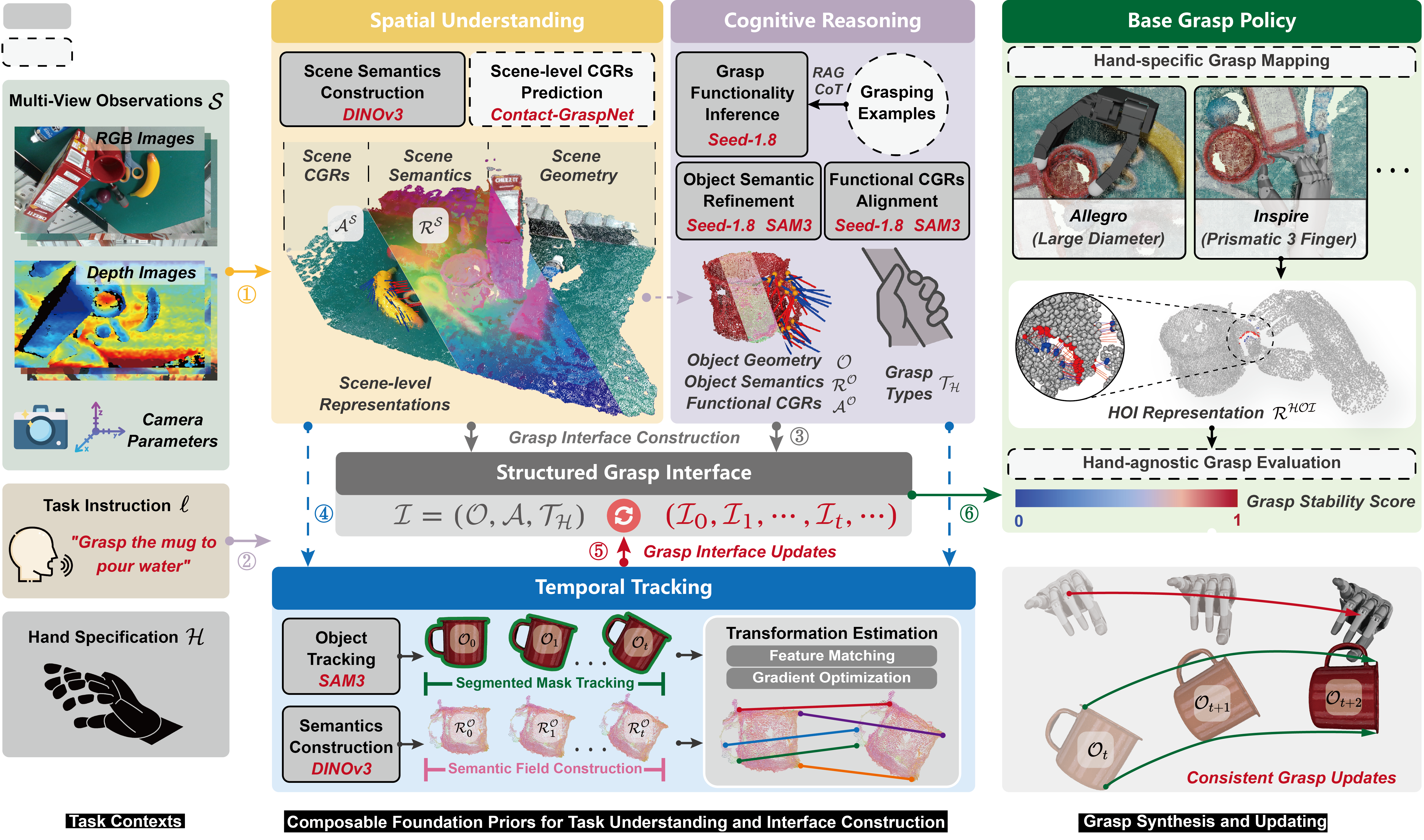
Task contexts and composable foundation priors form a structured grasp interface for the base grasp policy and executable grasps

The key idea of AdaRoboVLG is to decouple task-driven understanding from physical grasp synthesis by leveraging diverse foundation-model priors. It first composes diverse foundation-model priors to understand task contexts and organizes their outputs into a structured grasp interface. Based on this interface, a shared base policy then generates executable grasp poses and enables generalization across different robotic hands.

AdaRoboVLG method overview

(1) Structured Grasp Interface. The interface organizes task-dependent information into a unified representation consisting of object geometry, Contact Grasp Representations (CGRs), and hand-compatible grasp types.

(2) Base Grasp Policy. The policy first converts this interface into executable grasp poses through hand-specific grasp mapping. It evaluates candidate grasps using a hand-object interaction (HOI) representation and a hand-agnostic grasp decision model, enabling generalizable grasp synthesis across different robotic hands.

(3) Composable Foundation Priors. The spatial prior module extracts scene-level CGRs for clutter-aware grasping; the cognitive prior module infers task-consistent grasp intents to support functional grasp synthesis; and the temporal prior module estimates target motion and continuously updates the structured grasp interface for dynamic grasping.

To validate the effectiveness of AdaRoboVLG, we organize the experiments around six key questions. At the component level, we evaluate the cross-hand generalization capability of the base grasp policy and the contribution of individual spatial, cognitive, and temporal priors in simulation. At the system level, we further evaluate the composability of these priors in complex real-world tasks and the extensibility of the framework toward new capabilities.

Base Policy

Complementary Priors

System Evaluation

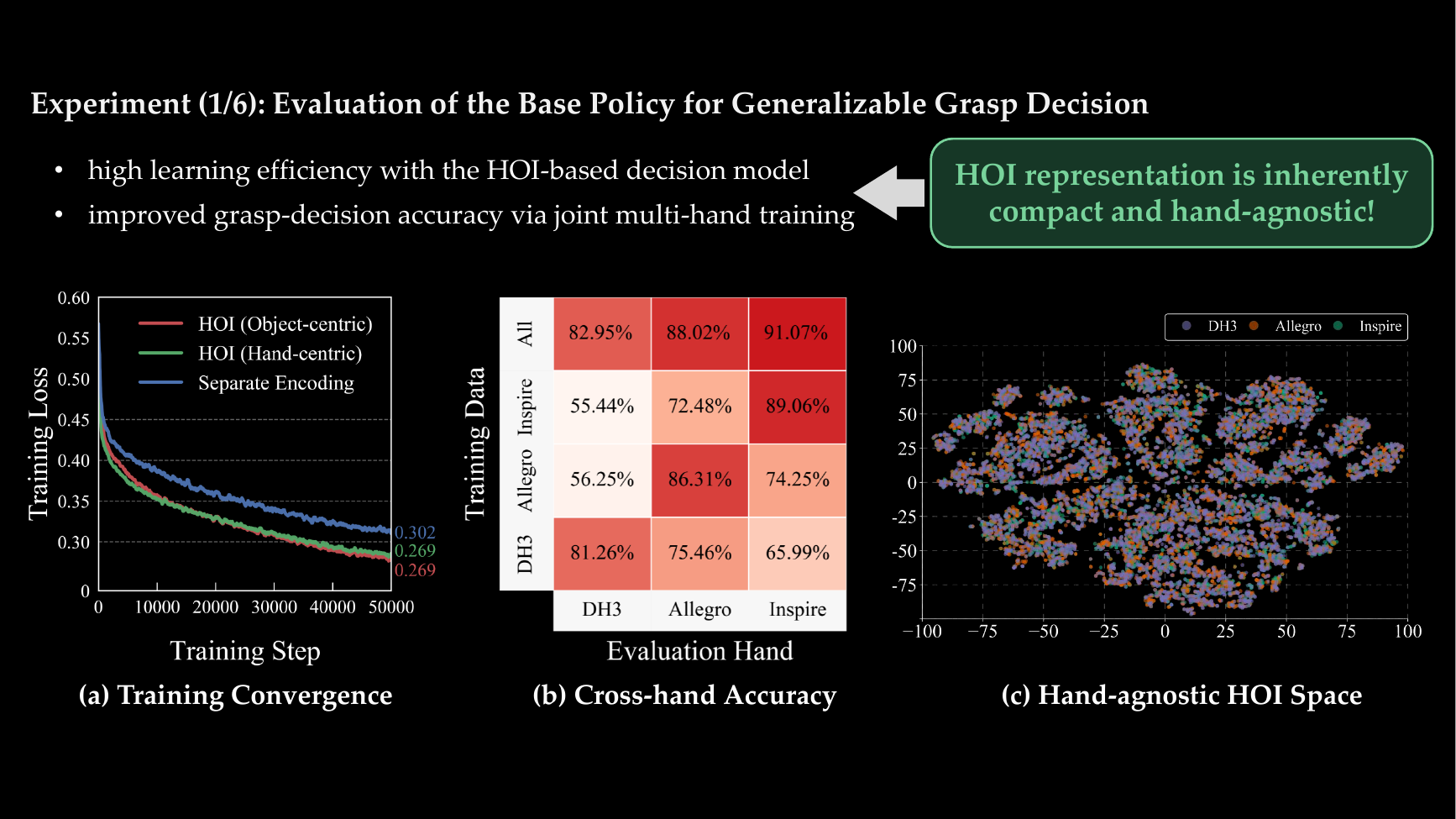
Experiment (1/6): Evaluation of the Base Policy for General Grasp Synthesis

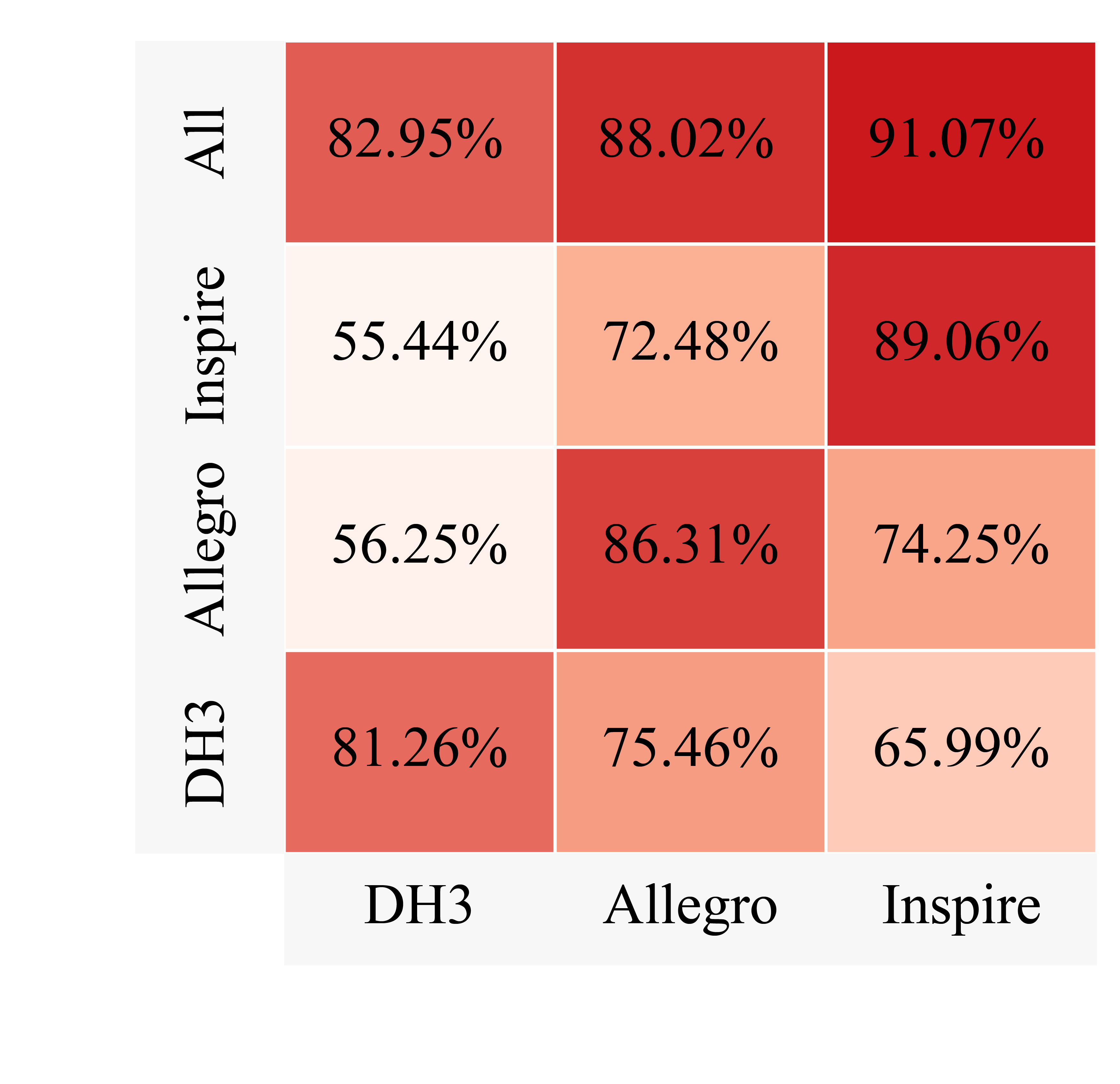
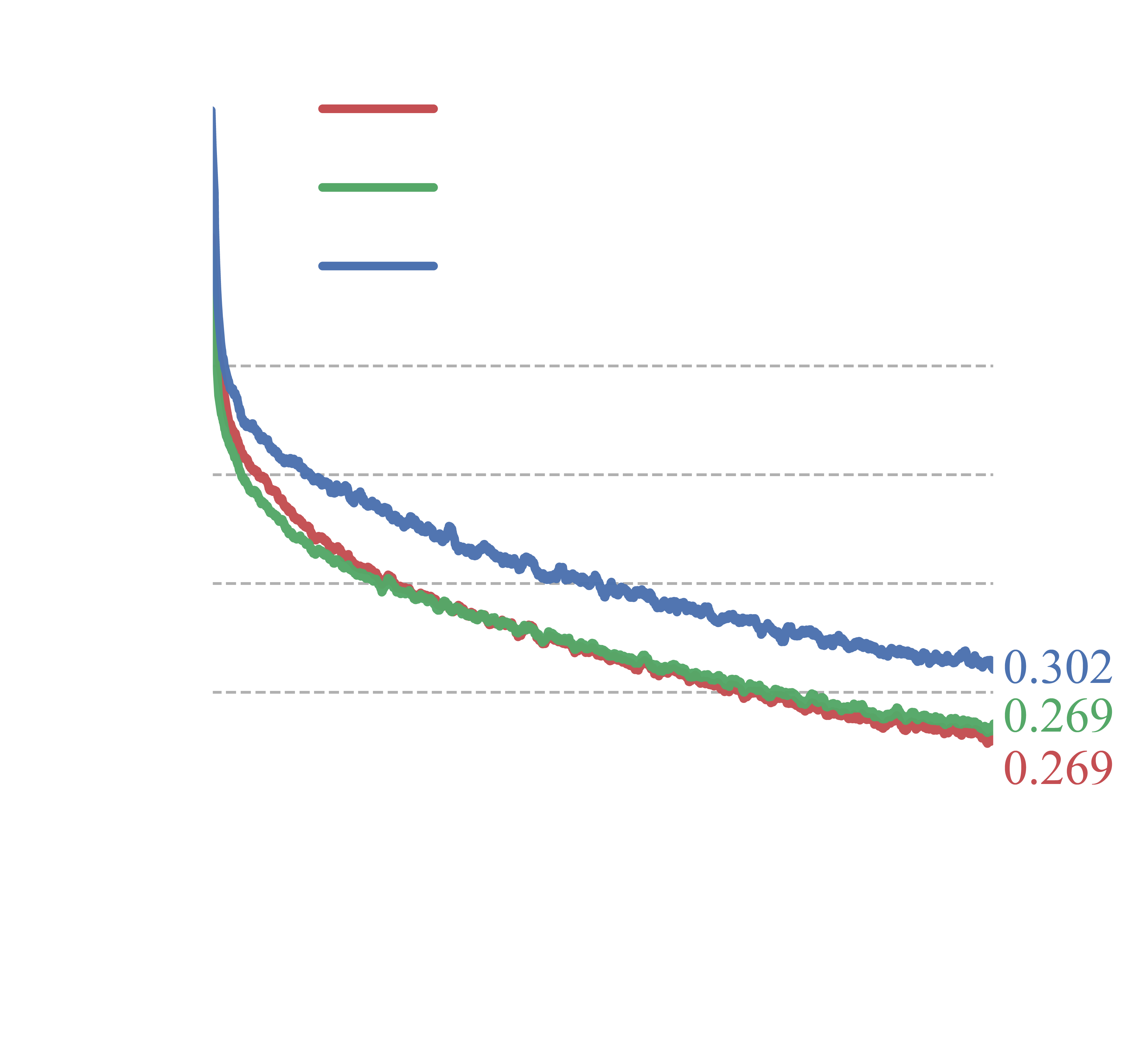
The HOI representation (a) is inherently compact and hand-agnostic. It not only (b) improves the learning efficiency of the grasp decision model, achieving faster convergence and lower training loss, but also (c) enables joint training across different robotic hands, facilitating cross-hand generalization of the base grasp policy.
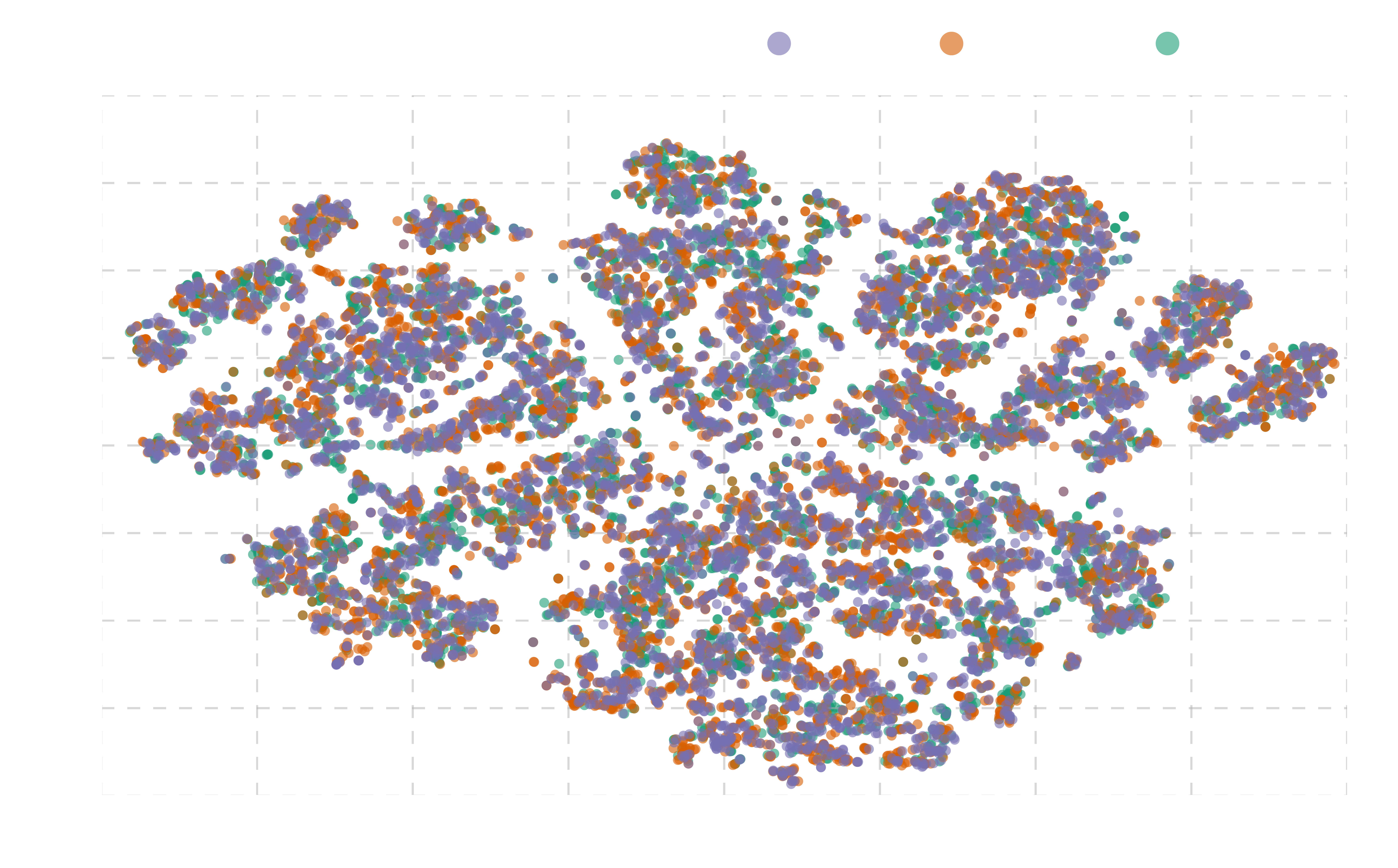
Hand-agnostic HOI embedding shared by DH3, Allegro, and Inspire hands
(a) Hand-agnostic HOI Space
Training loss convergence comparison for three interaction representations
(b) Training Convergence
Cross-hand grasp-decision accuracy matrix for DH3, Allegro, and Inspire hands
(c) Cross-hand Accuracy
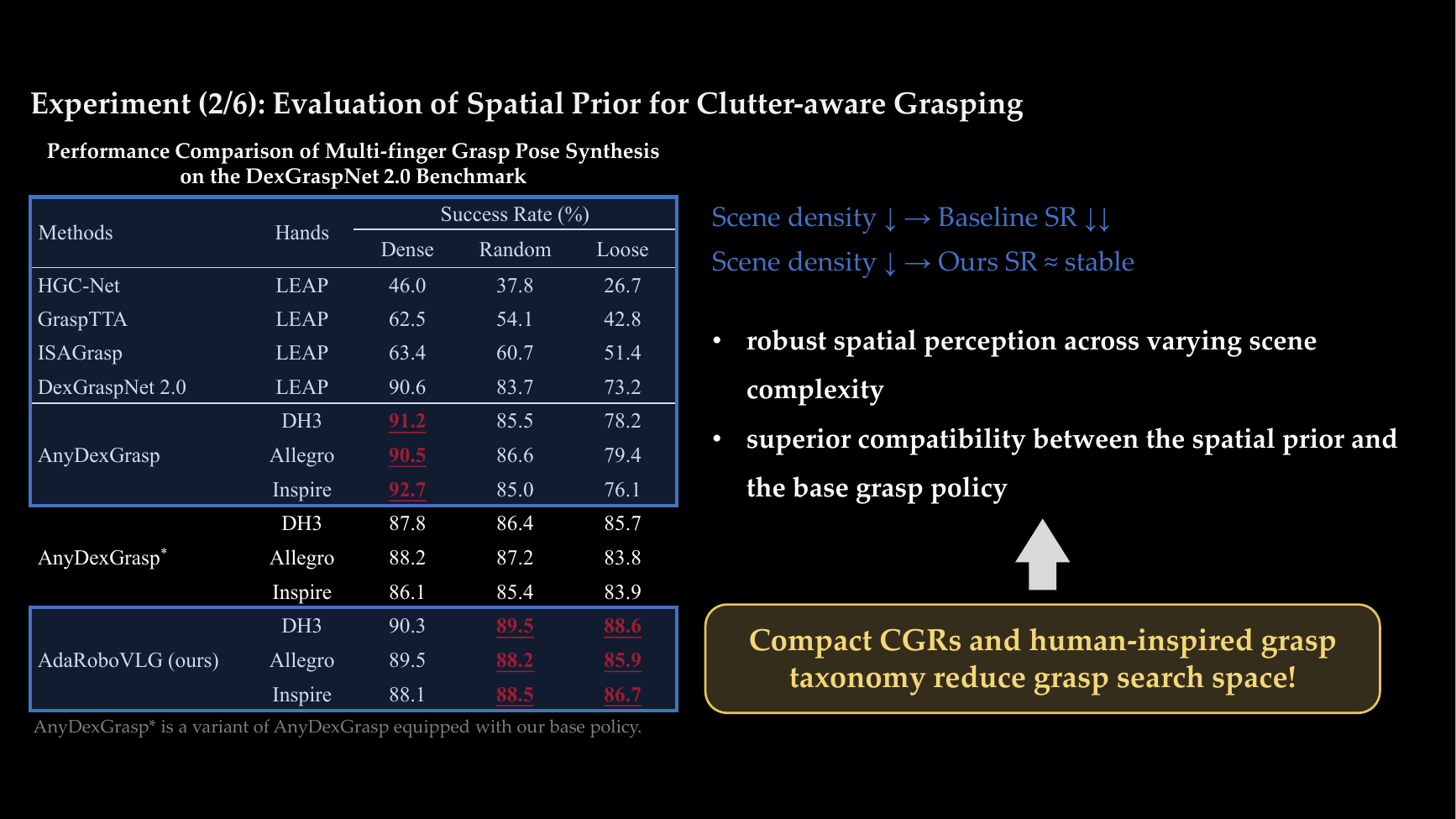
Experiment (2/6): Evaluation of the Spatial Prior for Clutter-Aware Grasping

To validate the spatial prior for clutter-aware grasping, we evaluate AdaRoboVLG on the DexGraspNet 2.0 benchmark across three robotic hands and diverse clutter levels.

Clutter-Aware Grasping
Scene 0100
Scene 0105
Scene 0110
Scene 0115
Scene 0120
Scene 0125
Scene 0130
Scene 0135
Scene 0140
Scene 0145
Scene 0150
Scene 0155
Scene 0160
Scene 0165
Scene 0170
Scene 0175
Scene 0180
Scene 0185

Quantitative results demonstrate that AdaRoboVLG consistently generates spatially feasible grasps across diverse clutter levels. This robustness comes from the compact CGRs and human-inspired grasp taxonomy, which reduce the grasp search space, as well as the effective compatibility between the spatial prior and the base policy.

Performance Comparison of Multi-Finger Grasp Pose Synthesis on the DexGraspNet 2.0 Benchmark
Methods Hands Success Rate (%)
Dense Random Loose
AnyDexGrasp DH3 91.2 85.5 78.2
Allegro 90.5 86.6 79.4
Inspire 92.7 85.0 76.1
AnyDexGrasp* DH3 87.8 86.4 85.7
Allegro 88.2 87.2 83.8
Inspire 86.1 85.4 83.9
AdaRoboVLG (ours) DH3 90.3 89.5 88.6
Allegro 89.5 88.2 85.9
Inspire 88.1 88.5 86.7

AnyDexGrasp* is a variant of AnyDexGrasp equipped with our base policy.

Experiment (3/6): Evaluation of the Cognitive Prior for Functional Grasping

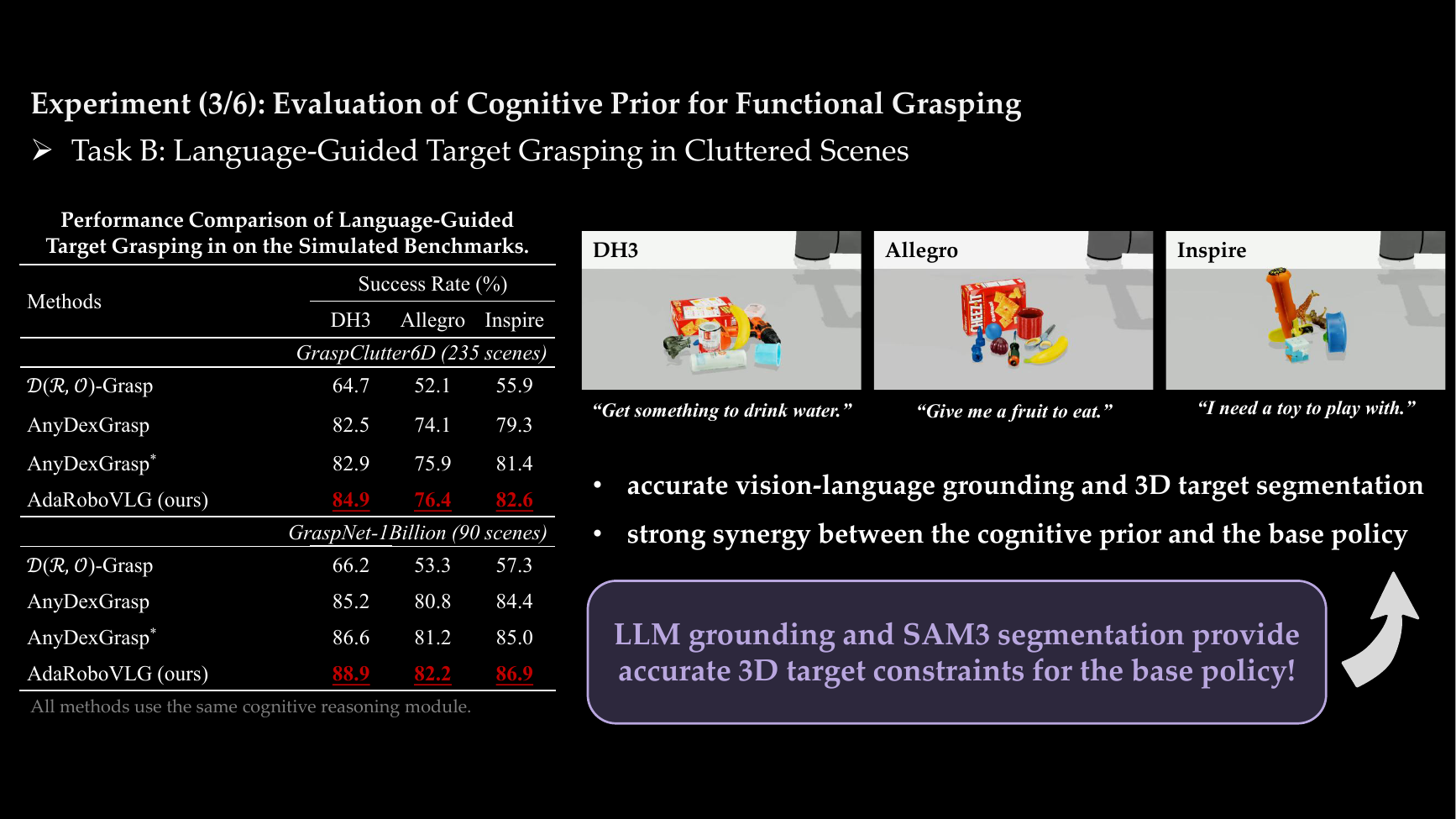
To validate the cognitive prior for functional grasping, we conduct two complementary evaluation tasks. The first evaluates grasp functionality inference on open-set instructions, while the second assesses language-guided target grasping in simulation.

Task A: Grasp Functionality Inference

Results from Task A demonstrate that equipping the LLM with RAG and CoT techniques significantly improves grasp functionality inference accuracy.

Grasp Functionality Inference Accuracy on an Open-Set Instruction Benchmark
Method Functional Part
Accuracy โ†‘
Grasp Type
Accuracy โ†‘
Base LLM0.820.63
Base LLM + CoT0.910.66
Base LLM + RAG0.850.78
AdaRoboVLG (ours)0.940.87

125 instructions | 57 manipulation tasks | 80 object categories

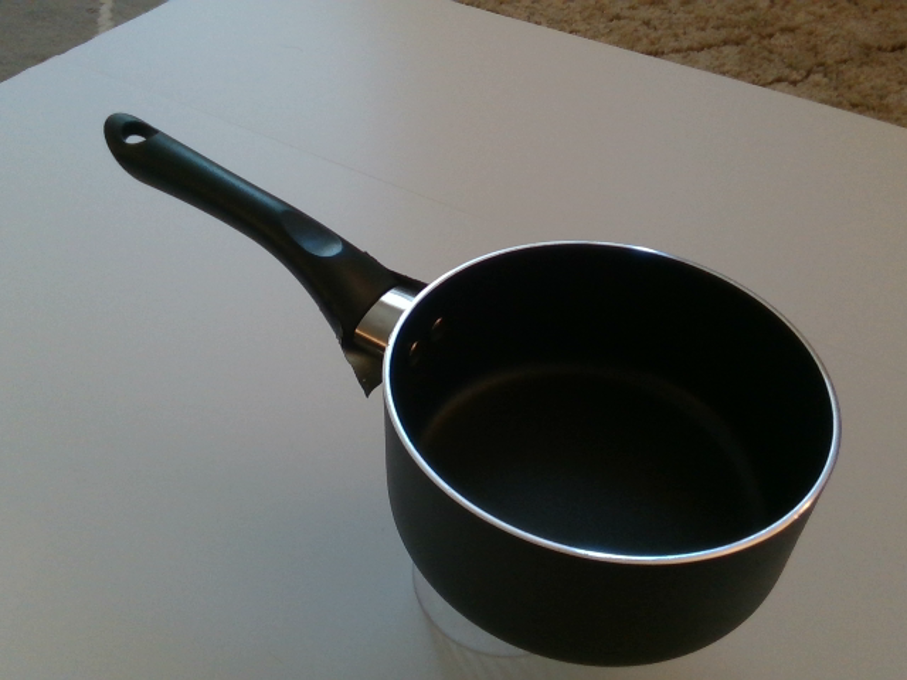
โ€œUse the pan to saute vegetables.โ€
Input image of a pan
Input Image
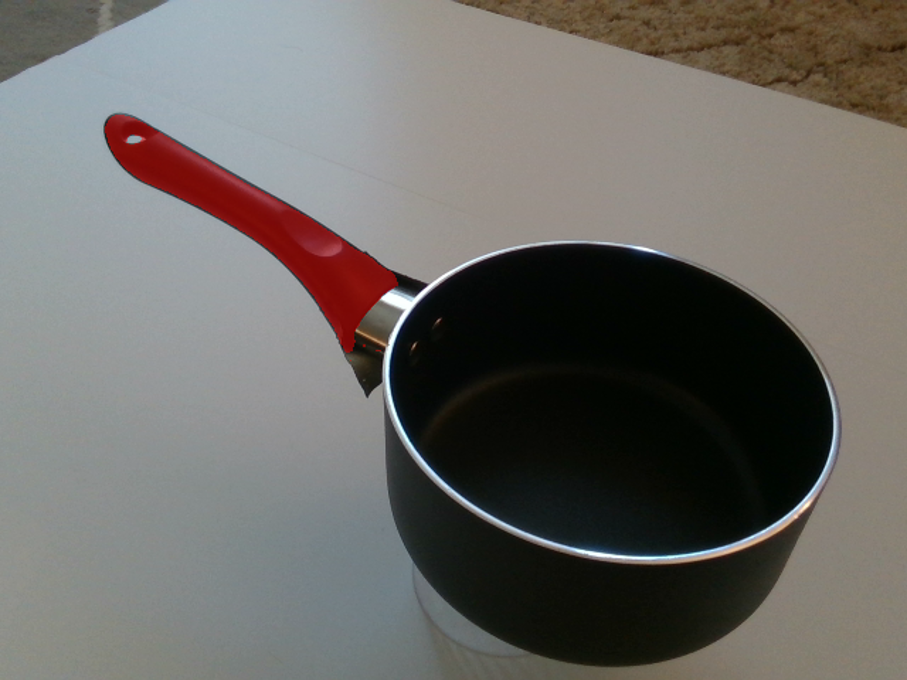
Functional part prediction for a pan
Functional Part handle
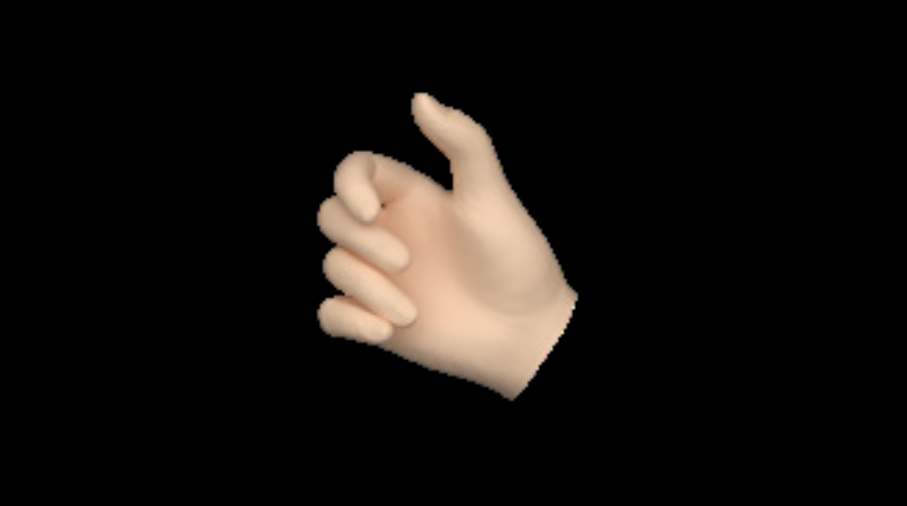
Medium Wrap grasp type
Grasp Type Medium Wrap

Task B: Language-Guided Target Grasping

Results from Task B verify that LLM-based grounding and SAM3-based segmentation provide accurate target constraints for generating executable and semantically consistent grasp poses across different robotic hands.

Language-Guided Target Grasping
Performance Comparison of Language-Guided Target Grasping on Simulated Benchmarks
Methods Success Rate (%)
GraspNet-1Billion (90 scenes) GraspClutter6D (235 scenes)
DH3 Allegro Inspire DH3 Allegro Inspire
๐’Ÿ(โ„›, ๐’ช)-Grasp 66.253.357.3 64.752.155.9
AnyDexGrasp 85.280.884.4 82.574.179.3
AnyDexGrasp* 86.681.285.0 82.975.981.4
AdaRoboVLG (ours) 88.982.286.9 84.976.482.6

All methods use the same cognitive reasoning module.

Experiment (4/6): Evaluation of the Temporal Prior for Dynamic Grasping

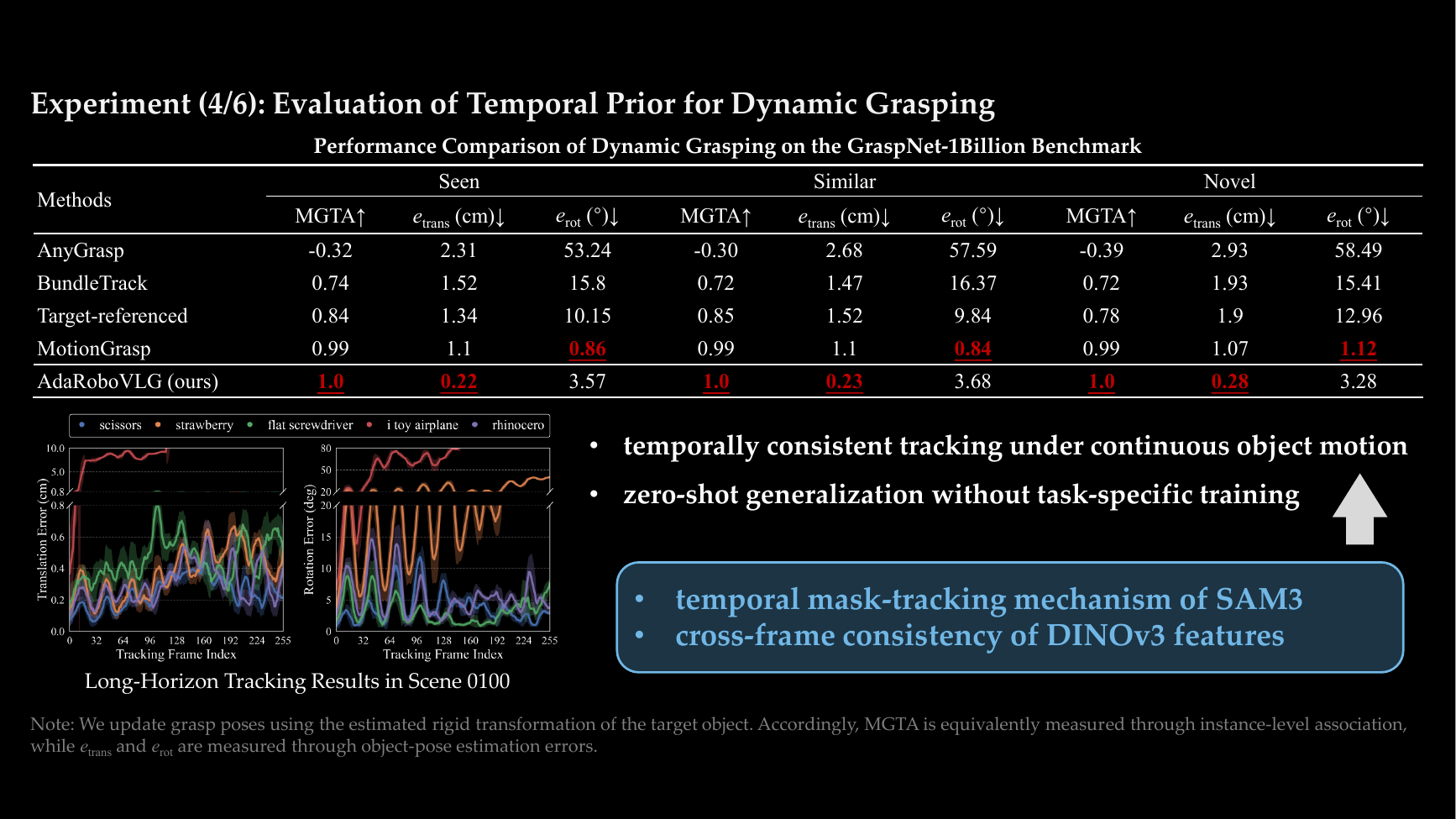
To validate the temporal prior for dynamic grasping, we evaluate AdaRoboVLG on the GraspNet-1Billion benchmark. It achieves perfect association accuracy, the lowest translation error, and competitive rotation error over consecutive tracking frames.

Performance Comparison of Dynamic Grasping on the GraspNet-1Billion Benchmark
Methods Seen Similar Novel
MGTA โ†‘ etrans (cm) โ†“ erot (ยฐ) โ†“ MGTA โ†‘ etrans (cm) โ†“ erot (ยฐ) โ†“ MGTA โ†‘ etrans (cm) โ†“ erot (ยฐ) โ†“
Nearest -0.8115.295.98 -0.8015.497.61 -0.8316.696.90
AnyGrasp -0.322.3153.24 -0.302.6857.59 -0.392.9358.49
BundleTrack 0.741.5215.8 0.721.4716.37 0.721.9315.41
Target-referenced 0.841.3410.15 0.851.529.84 0.781.912.96
MotionGrasp 0.991.10.86 0.991.10.84 0.991.071.12
AdaRoboVLG (ours) 1.00.223.57 1.00.233.68 1.00.283.28

We further present long-horizon tracking visualization. Notably, we update grasps using the estimated rigid transformations of the target object. Based on these transformations, we project the initial 3D semantic features of objects into the current image space for visualizations. Better alignment between the projected features and target objects indicates more accurate tracking.

Experiment (5/6): Integrated Evaluation in Complex Real-World Tasks

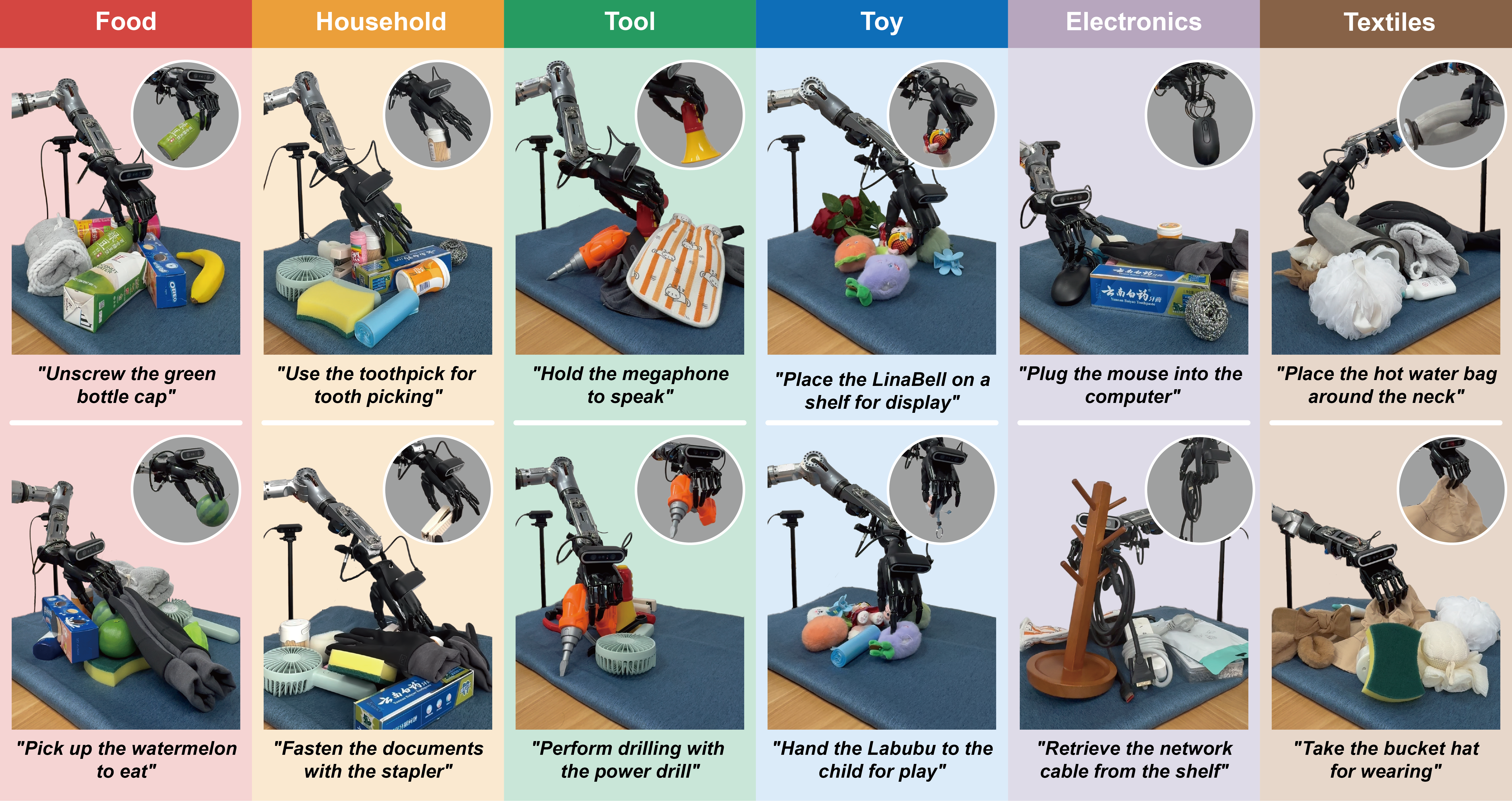
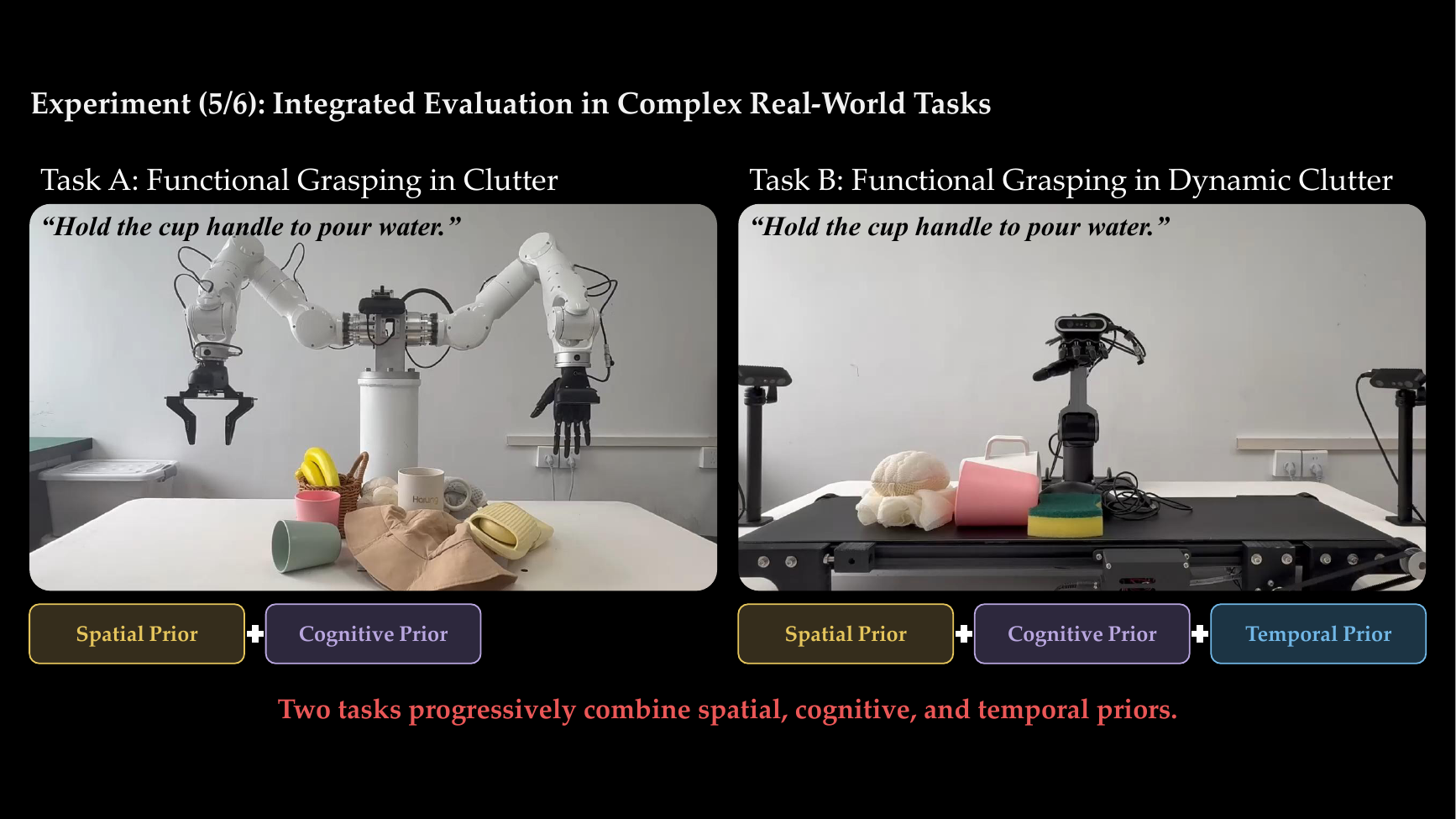
To validate the composability of these priors for complex real-world tasks, we conduct two experiments. Task A combines the spatial and cognitive priors for functional grasping in static clutter, while Task B further incorporates the temporal prior for functional grasping in dynamic clutter.

Task A: Functional Grasping in Static Clutter

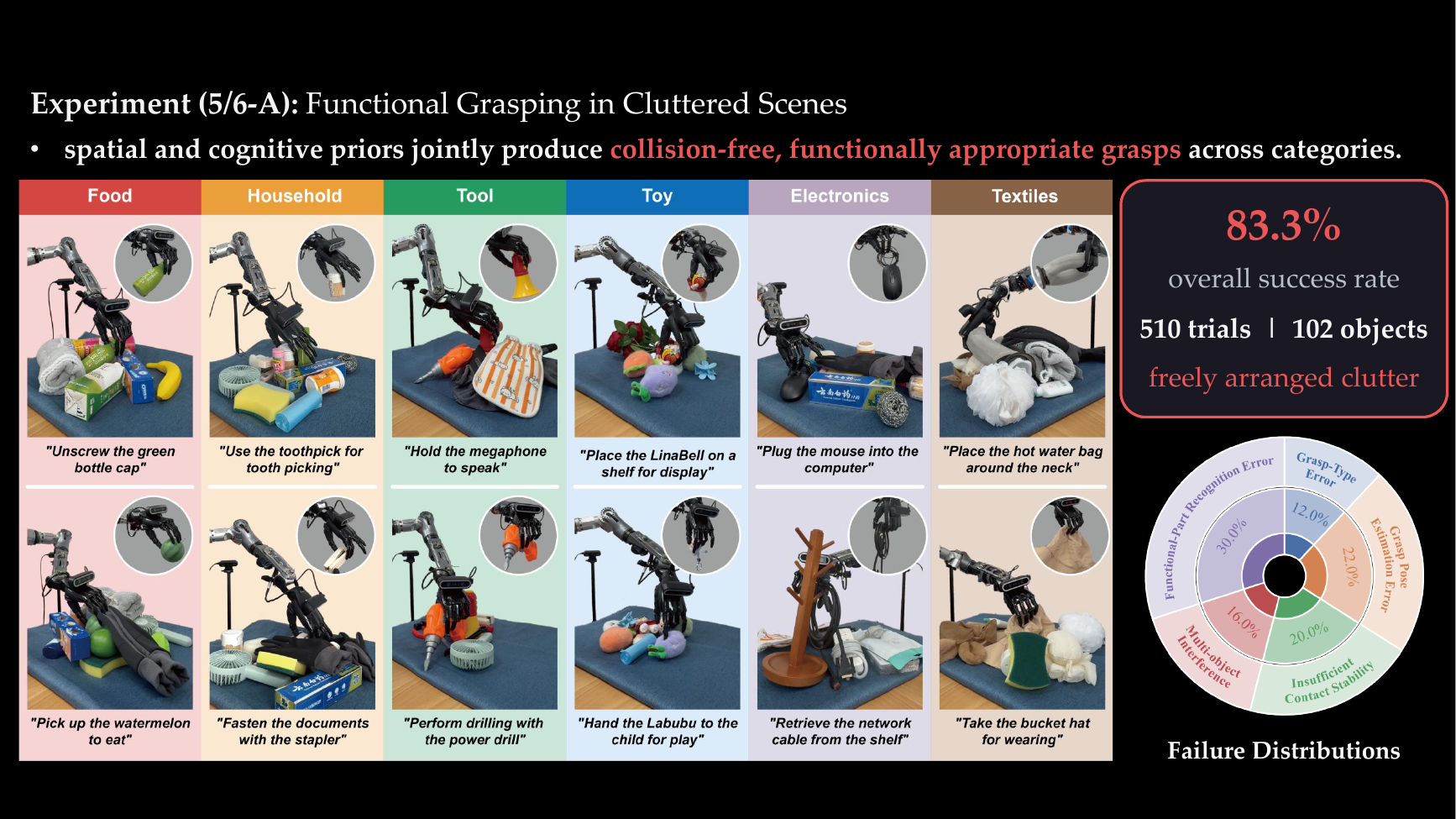
We test 102 everyday objects over 510 real-world grasping trials. For each trial, the spatial prior constrains grasp generation to avoid collisions with nearby objects, while the cognitive prior infers task-consistent functional grasp intents. By composing these priors, AdaRoboVLG generates spatially feasible and functionally appropriate grasp poses in cluttered scenes.

Twelve functional grasping tasks across food, household, tool, toy, electronics, and textiles categories
Functional Grasping in Clutter (videos are played at 2× speed)

Task B: Functional Grasping in Dynamic Clutter

We present representative results of functional grasping in dynamic clutter on a conveyor belt moving at 2โ€“5 cm/s with 16 target objects and multiple distractors. These results demonstrate the effective synergy among the spatial, cognitive, and temporal priors, enabling spatially feasible, functionally appropriate, and temporally consistent grasping in real-world dynamic scenes.

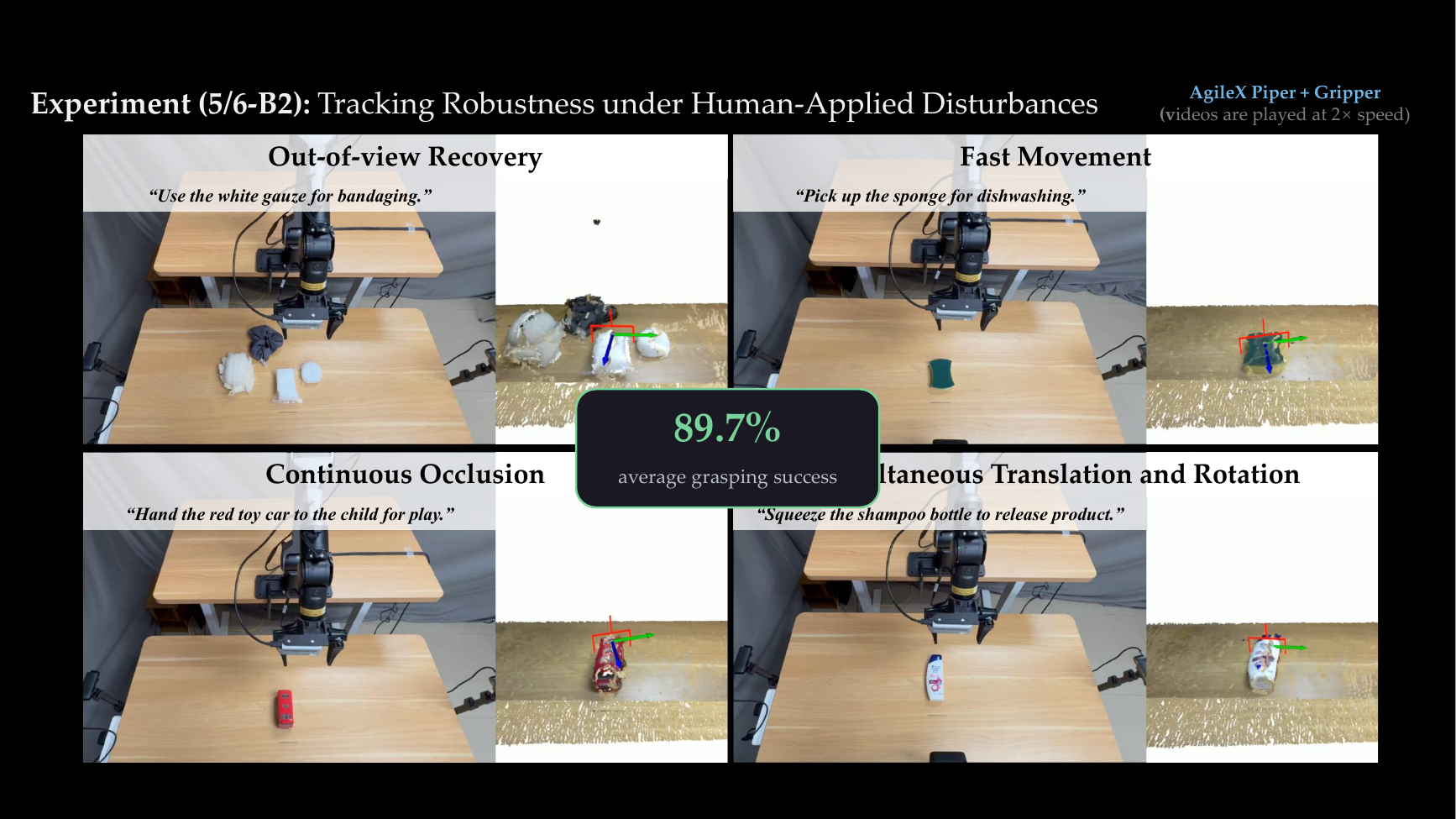
We further evaluate grasp tracking robustness under four human-induced disturbances across 10 objects with five trials per object, achieving an average success rate of 89.7%.

Grasp Tracking under Human-Induced Disturbances
Out-of-view Recovery

“Use the white gauze for bandaging.”

Fast Movement

“Pick up the sponge for dishwashing.”

Continuous Occlusion

“Hand the red toy car to the child for play.”

Simultaneous Translation and Rotation

“Squeeze the shampoo bottle to release product.”

Experiment (6/6): Extensibility of the Adaptive Framework

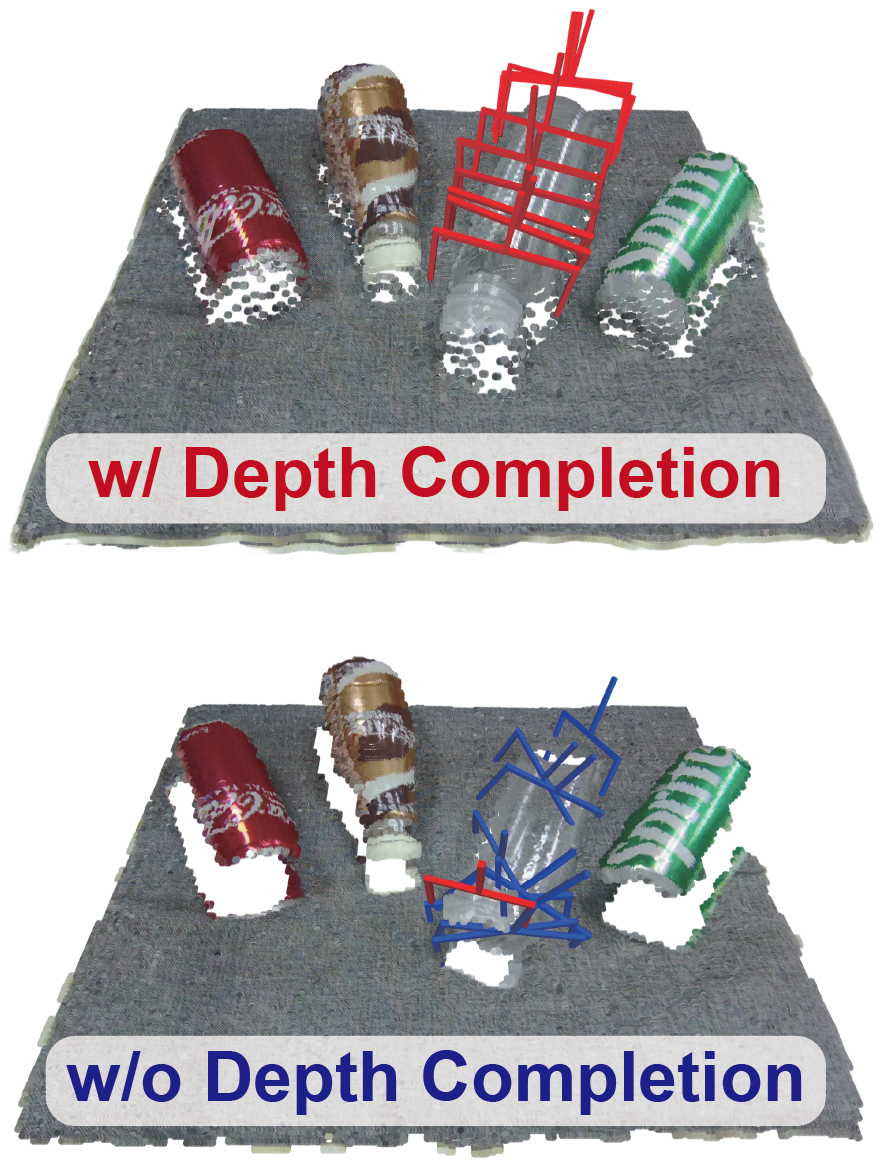
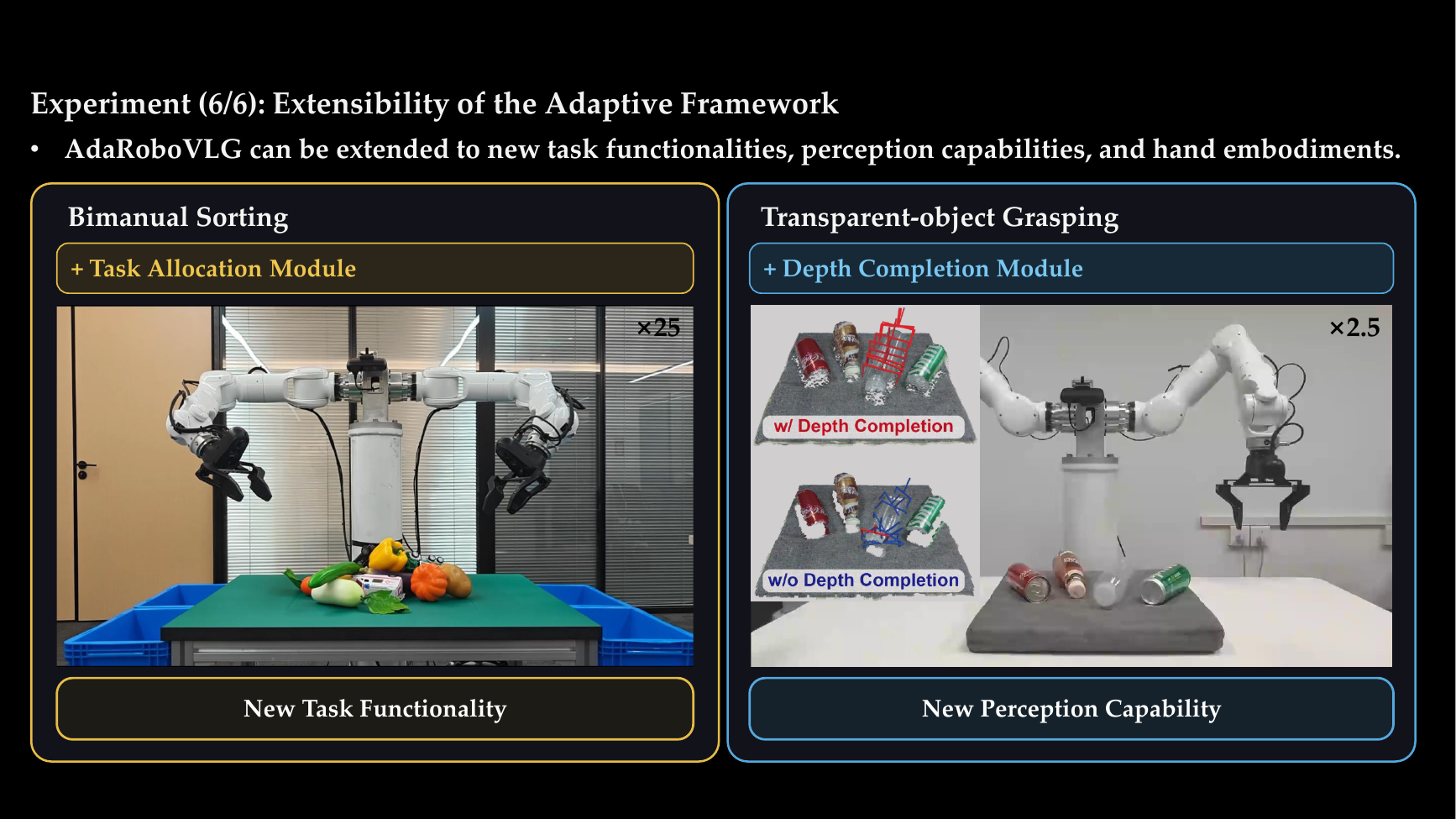
Finally, we demonstrate the extensibility of AdaRoboVLG. It enables new capabilities through additional modules without retraining the entire policy, such as bimanual sorting with task allocation and transparent-object grasping with depth completion.

Bimanual Sorting (videos are played at 25× speed)
Transparent-Object Grasping (videos are played at 2.5× speed)
Transparent-object grasping with and without depth completion